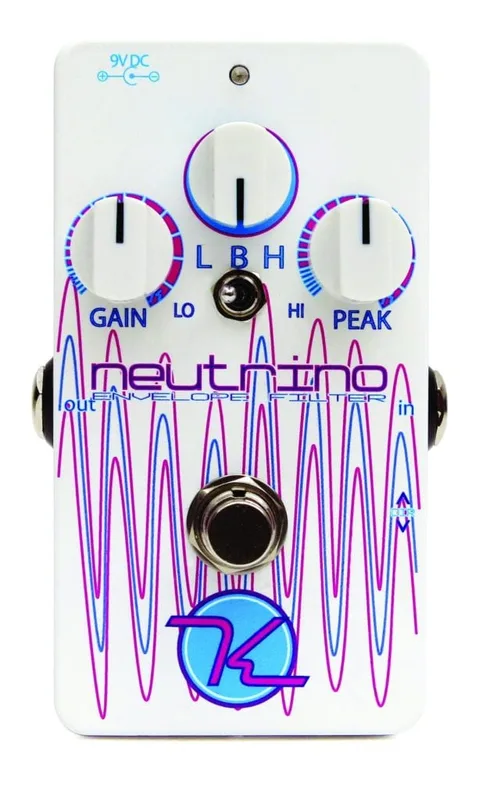


The Keeley Neutrino is an envelope filter pedal from Keeley Electronics, first shipped as the Neutrino Envelope Filter and later updated as the Neutrino Envelope Filter V2. An envelope filter, also called an auto-wah, sweeps a filter across your signal in response to how hard you play: pick harder and the filter opens further, pick softly and it stays closed. It is the effect behind much of the classic funk and "Jerry" rhythm guitar sound, and Pedal of the Day called the original Neutrino "a wonderful little box chock full of funk"12.
Both versions are built on a compact analog circuit that uses an opto-coupler, the same basic approach as the vintage envelope filters the pedal draws its character from. The V2 is described as 100% analog and made in the USA, with hand-selected opto-couplers that Sweetwater's demo presenter, Don Carr, said are "of an even higher grade than you'll find in a mint vintage original"345.
What the Neutrino does
The Neutrino tracks the level of your picking and moves a filter accordingly, which is why it is often compared to a wah pedal that rocks itself. Pedal of the Day's Mike B described the Gain control set correctly as sounding "like a wah pedal rocking back and forth, but without the extra effort on your part"1. In his review of the original, he found it "oozed that classic MuTron, 'Jerry' envelope filter sound, but in a way that was not overbearing, and added just the right amount of color to my tone"1.
The pedal gives you three filter types, chosen by the middle selector knob:
| Filter setting | What it does | How Pedal of the Day described the sound |
|---|---|---|
| L (Low-Pass) | Cuts off the high end | "darker and muddier, while retaining clarity"1 |
| B (Band-Pass) | Equal high and low cuts | "the most vocal-sounding of the three"1 |
| H (High-Pass) | Cuts off the low end | "cuts through the mix, and gives off a brighter tonal quality"1 |
The V2 is described as an envelope filter and auto-wah for guitar, bass and keyboard, so it is not limited to guitar players4. Don Carr's Sweetwater demo highlighted its range: "I really like how subtle and extreme this pedal can be," noting a wide sonic palette that works well with other pedals5.
The controls and the Range toggle
The control set is the same idea across both versions: input Gain, resonance Peak, a Filter selector, a tone Range control, and a Drive direction control3.
| Control | What it does |
|---|---|
| Gain | Sets the input level; also affects how quickly and to what degree the filter opens up15 |
| Peak | Sets how much "quack" there is, or how smooth you roll; turned up is more resonance, turned down is mellower and warmer45 |
| Filter selector | Chooses between Low-Pass, Band-Pass, and High-Pass filters14 |
| Range toggle | Switches between HI or LO, adjusting which frequencies are stressed when picking14 |
| Direction switch (side) | Sets whether the filter sweeps UP or DOWN as you attack, open to close or close to open145 |
| Volume (V2, side) | External output volume control2 |
The Peak knob spans a wide range of wah character. Mike B described it as adjusting "how much 'wah' sound you want in the mix, from a slight, warm, mellow tone coloring to a sharp, duck-like quack, and pretty much every other wah sound in between"1.
The Range toggle is the control that places the filter in the right part of the spectrum for your instrument and style. It goes back and forth between HI or LO and adjusts which frequencies are being stressed when picking1. In the Sweetwater V2 demo, the Lo setting with every knob at 12:00 was the recipe for the pedal's most famous documented sound5.
"Straight out of the box, with the Range toggle set to Lo and every knob at 12:00, this pedal nails that elusive 'Shakedown Street' auto-wah tone without any fuss."
The original pedal kept its look clean by putting the Drive switch on the side, recessed, and the output Volume inside the enclosure3. The V2 moves the Volume control to the outside of the pedal2.
The V2 and its opto-couplers
The V2, released in 2020, is a reworking of the original rather than a new design. Pedal of the Day, which had reviewed the first version almost five years earlier, wrote that the original "was one of our, and many other players' favorite filters EVER, but Robert and the Keeley crew didn't think it was grand enough"2.
The core of both versions is the opto-coupler. The V2's design is based on an opto-coupler fine-tuned to sound smooth and vowel-like4, and Pedal of the Day found the V2's opto-couplers "particularly smooth, giving you an amazing vowel-like tone"2. The V2 also uses hand-selected opto-couplers of a grade Sweetwater's demo described as higher than a mint vintage original5.
Two further changes define the V2:
- Improved note tracking over the original2
- Upgraded components throughout2
- A voltage-doubler enhanced power supply for extra headroom, so you maintain the highest headroom for your tone42
- An external output Volume control on the side, replacing the original's internal trimmer23
The enclosure is described by Delicious Audio as "an incredibly tough build means it will last for many decades to come"4. Pedal of the Day's verdict on the V2 was that "it's still the same amazing funk machine we all know and love, it just sounds…better"2.
Robert Keeley, the designer, has likened the Neutrino V2 to having "Jerry Garcia in a bottle"5.
In Sweetwater's video demo, Don Carr walks through each control, the filter bandpass selector, gain, peak, range, the side-mounted output level and direction switch, and demonstrates both subtle and extreme settings:
Versions at a glance
| Neutrino (V1) | Neutrino V2 | |
|---|---|---|
| Circuit | Compact opto-coupler based analog circuit3 | 100% analog, hand-selected opto-couplers45 |
| Filter types | Low-Pass, Band-Pass, High-Pass1 | High, Low, and Band Pass4 |
| Range toggle | HI or LO1 | HI or LO4 |
| Direction switch | Side-mounted, recessed; UP or DOWN13 | Up or Down4 |
| Output volume | Internal3 | External, on the side2 |
| Power supply | 9 VDC42 | 9 VDC, 25 mA, with voltage-doubler for headroom4 |
| Bypass | True bypass3 | True bypass4 |
The original Neutrino's output Volume is an internal trimmer, so matching the V2's external level control means opening the V1's enclosure. The V2 also draws 25 mA at 9 VDC, a figure to account for when planning a power supply34.
Where it came from
Keeley Electronics announced the original Neutrino Envelope Filter in 2014, with Vintage Guitar reporting it as a compact opto-coupler based envelope filter with controls for input Gain, resonance Peak, Filter selector, tone Range, and Drive direction, plus true-bypass switching3. Pedal of the Day reviewed and demoed it in January 20152.
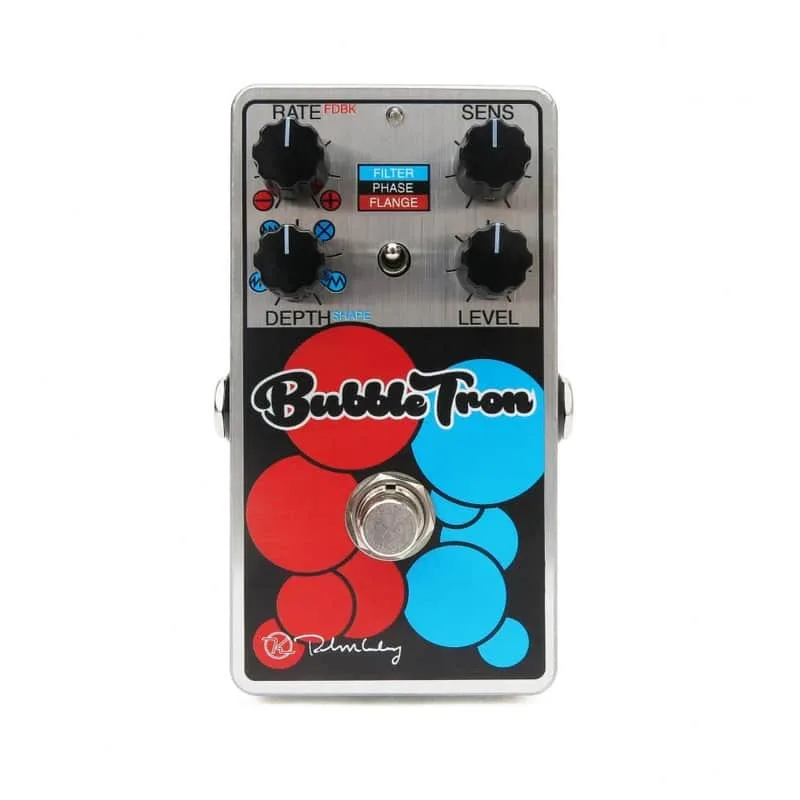
The V2 followed in 2020, with Pedal of the Day covering the new version's improved note tracking, upgraded components, and external output Volume control2. Keeley has continued in filter territory since, with pedals like the Le Bubble Tron carrying filter effects alongside flanger and phaser circuits.
Videos
Sweetwater
Keeley Electronics
Questions
How do you get the Shakedown Street tone on a Keeley Neutrino?
In Sweetwater's demo of the Neutrino V2, Don Carr found that with the Range toggle set to Lo and every knob at 12:00, the pedal produced the "Shakedown Street" auto-wah tone straight out of the box. So a V2 with those settings is the documented starting point for that Grateful Dead-style envelope filter sound.
Is the Keeley Neutrino analog?
Yes. The Neutrino V2 is described as 100% analog, built around an opto-coupler that was fine-tuned to sound smooth and vowel-like. The V2 uses hand-selected opto-couplers that Sweetwater's demo described as a higher grade than you would find in a mint vintage original.
What is the difference between the Keeley Neutrino V1 and V2?
The V2 keeps the same core feature set, three filter ranges, two directions, two frequency-center ranges and a Peak control, but adds improved note tracking, upgraded components, and an external output Volume control on the side of the pedal. The V1 had its output Volume control inside the enclosure. The V2 also has a new look.
Does the Keeley Neutrino work on bass?
The Neutrino V2 is described as an envelope filter and auto-wah for guitar, bass and keyboard, so it is built with bass players in mind. The Range toggle, which shifts which frequencies are stressed, gives bass players a way to place the filter where their instrument lives.
What changed between the Keeley Neutrino V1 and V2?
The V2's documented improvements are improved note tracking, upgraded components, and an output Volume control moved from an internal trimmer to an external side-mounted control. The V2 also introduced a voltage-doubler power supply for extra headroom and a redesigned enclosure.
Is the Keeley Neutrino true bypass?
Yes. The original Neutrino was reported with true-bypass switching when it shipped, and the V2 is likewise listed as true bypass. Both versions pass your signal unchanged when the effect is disengaged.
Sources (5)
- Keeley Electronics Neutrino Envelope Filter, Pedal of the Day (www.pedal-of-the-day.com), 2015-01-30
- Keeley Electronics Neutrino Envelope Filter V2, Pedal of the Day, 2020-10-21
- Keeley Ships Neutrino Envelope Filter, Vintage Guitar magazine, 2014-04-23
- Keeley Neutrino Envelope Filter V2, Delicious Audio, 2019-02-19
- Keeley Neutrino V2 Envelope Filter Pedal Demo, Sweetwater, 2019-12-02